
Download This White Paper 🚀
Introduction
This white paper is designed for business leaders seeking to understand how to leverage AI effectively in their organizations. It does not provide detailed technical information about AI technologies, nor is it intended for those seeking to learn about current AI technology trends.
Chapter 1: Global Business Premises Built on AI Adoption
This chapter introduces how leading enterprises worldwide, particularly in the United States, are already implementing AI in their operations and advancing toward production-level deployment. By contrast, Japanese enterprises remain primarily in pilot and experimental phases. Moreover, while the global market is moving beyond generative AI toward multi-agent coordination—where AI agents collaborate across departments to optimize enterprise-wide outcomes—Japanese organizations typically pursue departmental optimization, making holistic business optimization difficult to achieve.
Chapter 2: AI Adoption Challenges Facing Japanese Enterprises
While the gap in AI adoption between Japan and the rest of the world continues to narrow, Japanese enterprises face three critical challenges. First, they lack strategic vision; AI implementation remains disconnected from overall business strategy, focusing instead on near-term objectives such as efficiency gains and cost reduction rather than long-term growth and new business creation. Second, there is an acute shortage of digital talent skilled in emerging technologies, coupled with a significant skills gap. Both technical specialists and general employees lack sufficient AI literacy. Third, a deeply ingrained organizational culture that avoids failure and favors precedent over innovation creates substantial resistance to operational transformation through AI adoption.
Chapter 3: Pathways for AI-Driven Business Transformation
This chapter addresses the practical process Japanese enterprises should follow to leverage AI for operational transformation. While numerous learning resources and methodologies exist for understanding generative AI and AI applications, many organizations struggle to translate this knowledge into actionable business operations. This chapter provides guidance on the process for implementing AI-driven transformation.
Chapter 4: Why Now?
In an era characterized as VUCA—volatile, uncertain, complex, and ambiguous—competitive threats may emerge unexpectedly, even when current business performance appears strong. While organizations can respond reactively to disruptive change, strategic advantage belongs to those who anticipate disruption or lead transformation proactively. This chapter explores why the current moment is critical for AI adoption.
Chapter 5: From AI Implementation to AI-Integrated Management
The final chapter addresses the shift from "deploying AI" to "embedding AI within management processes." While automation often evokes images of factory automation and manufacturing robotics, the question remains: Are sales, marketing, and back-office functions experiencing comparable automation? Manufacturing facilities achieve productivity gains through incremental improvements measured in seconds and milliseconds. White-collar environments contain substantial untapped potential for productivity enhancement, yet meaningful advancement proved elusive before AI emerged. Today's AI technologies can dramatically enhance white-collar productivity. One approach is to begin with bold hypotheses: Can AI assume all current tasks? Can offices operate with minimal human presence? The key is establishing clear distinctions between tasks best performed by humans and those appropriate for AI.
Chapter 1: Global Business Premises Built on AI Adoption
The world's business landscape is undergoing a fundamental transformation. The central premise driving this shift is "business operations predicated on AI integration." While the term "management" encompasses broader strategic considerations, it also includes operational business practices—the totality of how enterprises conduct business.
Just as Digital Transformation (DX) created competitive differentiation, the next decade will determine corporate survival based on "how effectively AI is embedded into business operations." This is not hyperbole. On July 2, 2024, Microsoft announced record profits yet eliminated approximately 9,000 positions—4% of its global workforce—to redirect resources toward AI investment. While human roles diminished, AI began substituting for human work. Though enterprises perpetually seek operational efficiency, Microsoft's decision reveals the scale of AI's strategic significance: despite record quarterly profits in Q1-Q3 2025, the company prioritized AI infrastructure investment over headcount. The impact is profound. Similarly, McKinsey, the world's preeminent consulting firm, reduced its workforce by over 5,000—exceeding 10% of total employees—over the past 18 months, as generative AI fundamentally restructures consultant productivity and work methods.
However, framing AI impact solely through Microsoft and McKinsey's workforce reductions—viewing AI as programmer and consultant replacement—misses the true disruption. Generative AI extends beyond automating data collection and report generation or supporting decision-making. The fundamental shift is that AI possesses the capability to replace entire business processes, methodologies, and work systems previously performed by humans.
Vision of Advanced Enterprises Worldwide
Leading enterprises in the United States and China have already repositioned AI from an efficiency tool to the centerpiece of business strategy. American technology giants continuously deploy generative AI-embedded search, advertising, and cloud services to market, fundamentally transforming customer experience. The pharmaceutical industry has accelerated research and development timelines dramatically by integrating AI into drug discovery processes. Financial institutions strengthen market advantage through AI-powered risk analysis and sophisticated investment decision-making.
|
These organizations share a fundamental commonality: they do not debate "whether to adopt AI" but rather "how to embed AI into business operations." This reflects the baseline understanding that AI delivers efficiency, revenue growth, and profit enhancement—propositions beyond question. Consequently, AI-driven business process redesign and business model innovation extend across all functions: operational excellence, customer experience, marketing, research and development, talent management, and financial accounting.
AI Impact Transcends Operational Efficiency
AI effectively reduces costs and enhances operational efficiency. Capacity-dependent businesses—hotels, transportation, restaurants—depend on utilization rates; AI optimization improves occupancy. Route optimization in logistics enhances efficiency. Marketing automation and sales force automation potentially optimize current activities. Such operational applications are valuable.
However, the critical frontier is value creation.
Personalized, real-time service delivery tailored to individual customers on e-commerce and reservation platforms represents value creation. Large Language Models (LLMs) enable natural-language prompts such as "Book a hotel for [date] within [budget], minimum [size], single bed, within [distance] of station"—simplifying reservation processes. Integration across travel-related platforms—hotel, rental car, and flight reservation services—creates unified, seamless experiences. This is value creation.
Organizations can derive insights from massive internal and external datasets, simultaneously accelerating decision precision and speed in marketing, sales, and strategic management. Advanced demand forecasting and market simulation enable new business opportunities. Beyond decision support, AI can autonomously execute business processes within defined parameters. These shifts represent more than incremental improvement; they fundamentally reshape competitive positioning and enterprise advantage.
Prerequisites for AI-Enabled Business Models
What specifically constitutes AI-enabled business operations? Three essential elements converge: center operations on AI, adopt enterprise-wide approaches, and develop talent. Only when these three elements align does AI transformation become a sustainable competitive advantage.
Center Operations on AI
When designing new business processes or models—or reimagining existing ones—embed AI from inception rather than adding it as afterthought. Consider the hypothesis: "Can we replicate all existing operations through AI?"
ChatGPT, launched by OpenAI in November 2022, ignited the generative AI movement in 2023, rapidly transforming technology and consumer behavior. Current ChatGPT capabilities differ markedly from its predecessor. Today, AI generates text, images, video, audio, music, and code—with continued advancement anticipated.
Design business scenarios incorporating AI from the start, not constrained by current capabilities but informed by reasonable extrapolation and vision. Imagine the possibilities rather than codify present limitations.
Adopt Enterprise-Wide Approaches
Initial efforts focus on Proof of Concept (PoC) for specific functions or departments. However, foundational success requires enterprise-wide implementation. AI accelerates decision-making, action, and analysis exponentially. Departmental or process-level bottlenecks constrain enterprise-wide transformation. Strategic examination and deployment should presume AI utilization across all business scenarios and processes.
Develop Talent
This does not mean training IT or AI specialists. AI remains, presently, a tool lacking autonomous intelligence or independent will. The differentiator is workforce capability in leveraging this powerful tool. Less capable personnel produce lower-performing AI outputs. Conversely, highly capable personnel generate extraordinary AI-powered performance. Organizational success depends on developing personnel with foundational excellence—those possessing strong analytical capability, creative thinking, and strategic vision—enabling them to deploy AI effectively at advanced levels.
Chapter 2: AI Adoption Challenges Facing Japanese Enterprises
Absence of Strategic Vision
As of 2025, many Japanese enterprises pursue fragmented AI initiatives, remaining at the Proof of Concept (PoC) stage. Generative AI services such as ChatGPT and Gemini generate discussion; select companies conduct experimental deployments. Business operations increasingly leverage generative AI for document creation, presentation development, and business planning.
The Ministry of Internal Affairs and Communications released findings on July 5, 2024, from the "2024 Information and Communications White Paper," comparing domestic and international generative AI adoption. Survey results reveal that 46.8% of Japanese enterprises utilize generative AI in business operations—substantially below China (84.4%), the United States (84.7%), and Germany (72.7%).
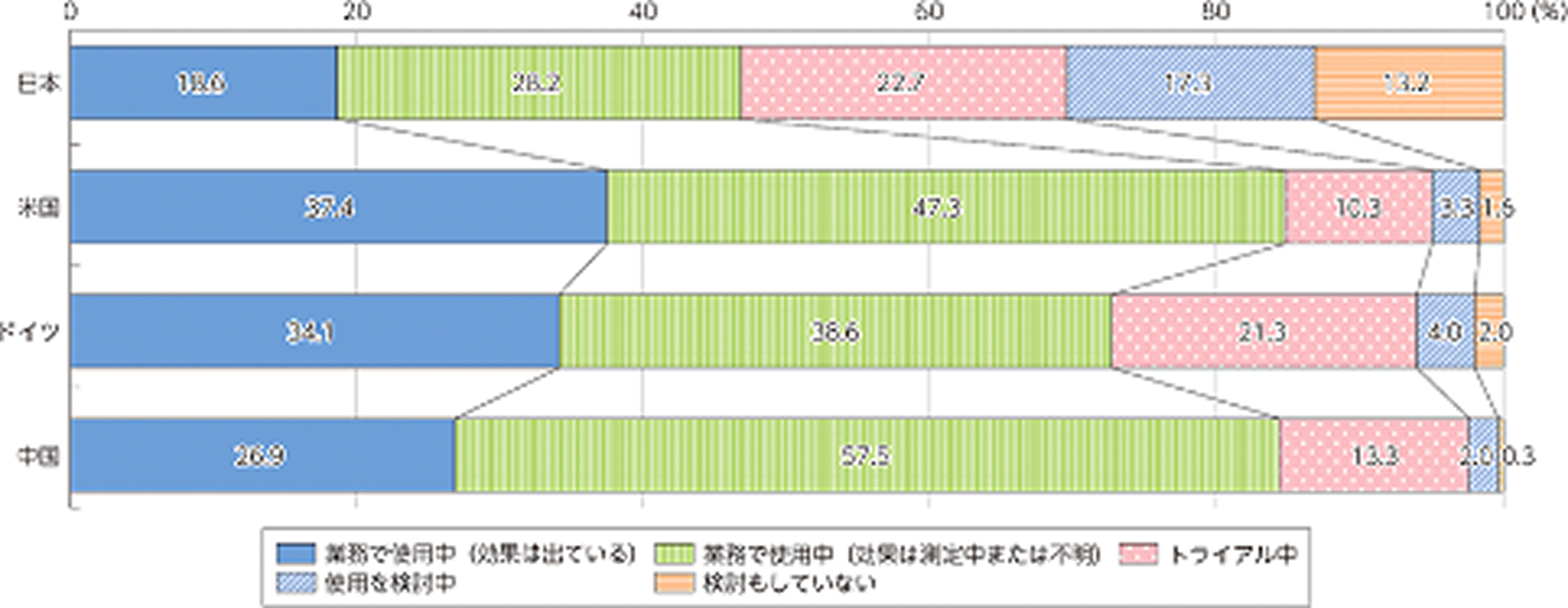
Regarding corporate AI deployment strategy, only 15.7% of Japanese respondents indicated "active adoption plans," compared to 71.2% in China—a significant gap. A September 2025 survey by Nikkei BP revealed that only 14.4% of Japanese employees perceive their companies' generative AI adoption as "significantly advanced" or "advanced," while 34.1% perceive their companies as "delayed" or "significantly delayed." Though premium generative AI services see adoption at individual and departmental levels, enterprise-wide deployment remains limited and, based on available data, appears considerably less prevalent.
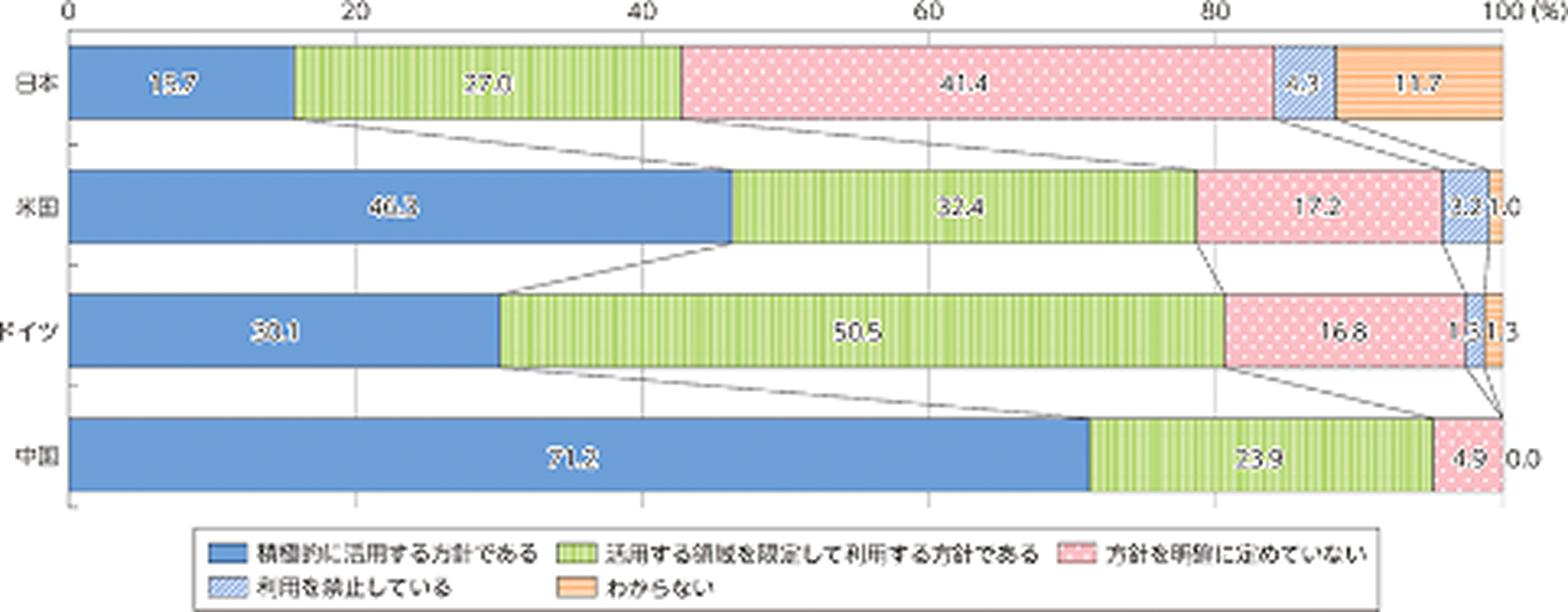
Given this adoption environment, business process and system transformation through AI progresses slowly. Fundamentally, the "in-business use" perspective reflects viewing AI solely as an efficiency or cost-reduction tool. AI should be understood as fundamentally transforming business—extending far beyond operational improvement.
Why Have Japanese Enterprises Yet to Unlock AI's Business Potential? What Prevents Japanese Organizations from Advancing AI Transformation?
The answer is straightforward: management does not approach AI strategically. The Nikkei BP survey confirms this diagnosis. Enterprises where employees perceive generative AI adoption as "delayed" demonstrate systematically lower executive commitment. In these organizations, executives personally avoid generative AI usage and communicate no coherent adoption strategy. Executive commitment levels lag substantially behind enterprises perceived as "advanced" in AI adoption. Regarding generative AI deployment, ask yourself this diagnostic question: Has your enterprise purchased premium generative AI licenses for all employees, or only select departments?
Executives must personally champion adoption—this is non-negotiable. However, transformation requires extending access organization-wide. Perhaps your organization harbors this mistaken assumption: that employees lack capability to master generative AI.
Competency develops through use, not prior to it. Personnel do not master methodology beforehand, then apply it. Instead, they apply the tool, and through application, mastery develops. The immediate strategic priority is straightforward: procure premium generative AI licenses for all employees enterprise-wide. If licensing costs present budgetary obstacles, contact our organization for solutions.
Today, providing each employee a personal computer is standard organizational practice—yet this became the norm only in the late 1990s. Windows 95 launched in 1995, enabling high-performance, affordable personal computing to proliferate. Internet infrastructure expanded rapidly. Business information gathering and communication horizons broadened dramatically.Remarkably—and perhaps unbelievably—email became standard corporate practice only in the late 1990s. Less than thirty years ago, organizations lacked email systems. Personal computers proliferated at astonishing organizational speed; soon, entire workforces exchanged messages electronically across internal and external boundaries. Today, business conducted without information technology infrastructure is inconceivable.
In 2023, ChatGPT emerged as generative AI's dominant application; millions adopted it immediately. By 2024, enterprises followed suit. Adoption velocity vastly exceeds 1990s pace. Within one decade, AI utilization will become as mundane as personal computing and email.
Transformation extends far beyond operational efficiency gains. Email evolution illustrates this trajectory. Currently, email automates response composition—humans draft messages, and systems accelerate transmission. The transformation transcends this: automated responses replace human composition entirely. Sales and marketing provide instructive examples. Currently, sales professionals and marketing specialists augment CRM and SFA usage with generative AI. The actual transformation will be categorical: AI will assume decision-making authority, dispatch communications, and schedule appointments on behalf of sales and marketing personnel.
Thirty years ago, visionary executives strategically deployed personal computers and computer systems. They recognized computing's transformative potential and invested deliberately. Contemporary leaders must deploy AI with comparable intentionality and strategic coherence.
AI potentially surpasses DX (Digital Transformation) in transformative power. Critics contend that Digital Transformation represented mere IT modernization, missing transformational opportunity. AI Transformation (hereafter "AX") transcends simple AI automation. The distinction is fundamental: IT cannot exceed human design parameters; AI exceeds design specifications and improves through input-output data.
When humans design IT systems, those systems function within predetermined parameters. Workflows are fixed; outputs are deterministic. IT systems cannot improve beyond original design unless humans intervene with updates.
AI operates differently. AI systems learn from data. They identify patterns humans did not anticipate. They adapt to novel situations. Most critically, AI systems improve continuously through processed data—improving without explicit human redesign.
Talent Shortage and Data Skills Gap
Progressive executives already recognize AI's potential and champion adoption across their organizations. Yet they may hesitate pursuing enterprise-wide AX implementation.
Three factors explain this hesitation: (1) insufficient personnel capable of executing AI-centric business process reengineering (BPR); (2) inadequate AI development talent; (3) unpreparedness of data infrastructure and data assets.
Insufficient Personnel for AI-Centric Business Process Reengineering
BPR remains valuable independent of AI adoption. However, it occurs intermittently rather than continuously. Business Process Reengineering—a concept introduced in 1993 by former MIT professor Michael Hammer and management consultant James Champy—gained global adoption. BPR fundamentally reconceives and reconstructs entire business processes to dramatically improve cost, quality, and speed. Unlike incremental operational improvement, BPR comprehensively redesigns roles, organizational structure, and information systems through holistic examination.
The term "dramatic" proves critical: effective BPR reduces headcount or workload by fifty percent or more. Currently, over fifty percent of Japanese corporate leaders identify "talent shortage" as a strategic challenge (Teikoku Databank). While this presents genuine difficulty, it simultaneously represents an AI opportunity. Substituting AI for human-executable tasks reduces labor requirements; applying AI-centric BPR achieves fundamental transformation and workload reduction.
Effective AI-centric BPR does not require exhaustive AI technical knowledge. Instead, organizations need personnel capable of observing operations holistically, thinking comprehensively from first principles, and imagining alternative operational models. Such individuals must question existing processes and envision improved operational states. While internal BPR teams remain essential, AI-centric approaches warrant considering Forward Deployed Engineers (FDEs).
FDEs embed within client environments, deeply understand operational requirements, bridge technology and business domains, and support solution development, deployment, and operational management through project completion. The defining characteristic: FDEs assume accountability for measurable results. Consequently, FDEs require advanced technical capability coupled with exceptional client communication proficiency and business acumen.
Simultaneously, many organizations lack internal personnel capable of leveraging AI effectively. This challenge cannot resolve overnight. While internal AI-capable personnel remain necessary, the immediate approach involves procuring AI expertise, knowledge, and capability externally, then accelerating internal knowledge and capability transfer. Historically, organizations delegated system development to System Integrators—firms that develop, build, and operate systems. However, this approach fails to build internal system development knowledge, expertise, and capability.
Ideally, organizations should pursue AX alongside firms committed to transferring AI knowledge, expertise, and capability—firms employing FDEs. This demands urgently securing internal personnel possessing foundational AI knowledge.
Inadequate AI Development Talent
Previous discussion emphasized urgently securing internal AI personnel with foundational knowledge. How practically can organizations accomplish this?
Here, "AI talent" denotes personnel capable of developing AI systems—not merely operating generative AI. The following approach develops advanced AI practitioners from existing internal IT engineers.
First, organizations must prioritize acquiring foundational technical skills.
Developing AI systems for internal deployment requires building AI agents and Model Context Protocol (MCP) servers. These development initiatives demand broad foundational technology understanding.
Programming languages include Python, JavaScript, and TypeScript. Cloud platforms—AWS, GCP, Azure—require IaaS/PaaS operational proficiency. API and microservices design demand REST, gRPC, Docker, and Kubernetes expertise. Data infrastructure requires SQL and NoSQL competency. AI fundamentals necessitate machine learning frameworks—PyTorch and TensorFlow—plus agent frameworks including LangChain, LlamaIndex, and Haystack. Natural language processing requires Retrieval-Augmented Generation (RAG) understanding.
While mastery across all domains may exceed practical necessity, developing full-stack engineers with comprehensive technical breadth proves essential for building AI agents and MCP servers capable of substituting for internal operations. Demanding these advanced technologies from personnel without prior engineering or programming experience proves unrealistic. Recruitment and development efforts must target individuals with substantial historical engineering or programming backgrounds.
Second, organizations must strengthen foundational skills through structured external collaboration.
FDEs—embedding within client environments, deeply understanding operational requirements, bridging technology and business domains, and supporting solution development, deployment, and operational management—represent optimal technology transfer sources.
Organizations should procure external FDEs, compose integrated teams pairing external FDEs with internal advanced personnel, and facilitate systematic technology transfer. Upon successful transfer completion, internal personnel assume FDE responsibilities, subsequently developing next-generation internal talent through mentorship and direct knowledge transfer.
Insufficient Data Infrastructure and Data Asset Preparation
AI effectiveness depends fundamentally on data availability. Yet Japanese enterprises frequently compartmentalize data by functional department. Sales departments maintain CRM systems; manufacturing departments operate CAD/CAM, IoT, and PLM systems; administrative functions use ERP—resulting in siloed systems lacking enterprise-wide integrated data infrastructure.
Additionally, paper-dependent and Excel-dependent organizational cultures persist widely. Organizations supplement major systems with macro-laden Excel spreadsheets. Data remains undigitized or accumulated as unstructured data. Many executives and leaders hesitate pursuing serious AI implementation, believing inadequate data assets prevent substantive progress.
However, AI continues evolving rapidly. A decade ago, machine learning and deep learning required meticulous data preparation and structuring. This requirement has largely disappeared. Generative AI demonstrates this evolution—ingesting diverse internet data formats for training without prerequisite data standardization. Structured data preparation has become unnecessary.
The historical principle—"Data represents corporate assets; unstructured, inaccessible data lacks asset status"—is now obsolete. Currently, any electronic data AI systems can process—regardless of format—constitutes valuable corporate assets. However, metadata definition (data labels and semantic meaning) remains important for AI system effectiveness.
Organizational Culture and Resistance to Transformation
Perhaps the most significant impediment to AI adoption in Japanese enterprises is systematic risk aversion. Institutional factors and organizational culture drive this orientation. While this cautious posture preserves corporate stability, it simultaneously forecloses growth opportunities in today's intensely competitive global environment.
System-Based Safety Orientation
Though lifetime employment and point-deduction personnel evaluation systems no longer function institutionally, their historical role in traditional Japanese management fundamentally shaped executive and employee behavioral patterns. Implicit commitments to employment stability persist, and if personnel evaluation systems operate on point-deduction mechanisms, employees avoid risk-taking and prioritize failure prevention. Fear of failure prioritizes organizational stability over growth investment, fostering risk-averse cultural orientation.
Long-term growth perspectives have deteriorated in recent years. Ministry of Education, Culture, Sports, Science and Technology (MEXT) Science, Technology, and Academic Policy Research Institute data reveal a concerning pattern: Japanese enterprises increase research and development and capital investment at substantially lower rates than US counterparts. While international enterprises emphasize short-term returns, Japanese enterprises demonstrate caution toward both short-term and long-term investment, failing to commit necessary resources regardless of timeframe.
Japanese Organization-Specific Cultural Barriers
Risk aversion embeds deeply within organizational culture through three mechanisms.
First: Consensus-Driven Decision-Making Processes
- Japanese corporate culture prioritizes achieving universal stakeholder consensus through "ringi" (circulation system) and "nemawashi" (behind-the-scenes consensus-building). While this approach minimizes errors and preserves quality and reliability, decision-making consumes substantial time. Modern markets demand rapid response; consensus-driven processes obstruct risk-taking and innovation adoption.
Second: Zero-Risk Orientation
- When new business or project proposals emerge, leadership and decision-making bodies focus disproportionately on failure risk mitigation and precedent adherence rather than success probability. They demand "evidence of failure prevention" and "historical precedent" rather than "evidence of success potential." This orientation, combined with national cultural seriousness, prematurely terminates innovative concepts through negative framing, yielding "risk-averse management" as organizational default.
Third: Japanese Collective Culture
- High organizational homogeneity and conformity discourage dissent from established values and customs. Organizations prioritize "business as usual," "harmony," "existing rules," and "shared benefit" over change and innovation. Preserving group cohesion supersedes pursuing transformation, yielding organizational conservatism as institutional norm.
Chapter 3: Pathways for AI-Driven Business Transformation
This chapter presents a ten-step process for leveraging AI to transform business operations. Each step provides strategic guidance for advancing from concept to enterprise-wide deployment.
Step 1: Define Clear Purpose for AI Adoption
Purpose, objectives, and supporting methodologies require explicit definition before any initiative launch. Examples include: "resolve XXX business challenge," "eliminate XXX operational function," "reduce delivery timelines by fifty percent," "reduce headcount by fifty percent." While various management challenges warrant consideration, focus on how AI improves quality, cost, and speed within core business resources: people, materials, capital, and information.
This step demands sharing and achieving consensus on KGI (Key Goal Indicator), KPI (Key Performance Indicator), CSF (Critical Success Factor), and supporting scenarios. Alignment among stakeholders proves essential for subsequent phases.
Step 2: Conduct Operations Inventory and Identify AI Opportunities
This step emphasizes three principles: SMALL, SPEED, SUCCESS. Achieve results through small actions executed rapidly, yielding success outcomes. Therefore, identify domains offering high impact with straightforward implementation.
While aspirational goals may include reducing or fundamentally transforming specific operations, the strategic approach prioritizes initial success: small scale, rapid execution, tangible outcomes. Before tackling significant challenges, establish momentum through achievable wins.
Identify high-impact, readily implementable domains through business flow visualization and decomposition, Activity-Based Costing (ABC) analysis, and quantitative metrics such as error rates or conversion rates. If business operations lack clarity or visualization, conduct comprehensive operations inventory at this stage. This step produces multiple use cases with individual impact scoring—assessing potential outcomes should each succeed.
Step 3: Visualize Data and IT Infrastructure
This step inventories existing data: location, definition, quality, access authority, security parameters, data stores (databases, data lakes, data warehouses, Excel systems), and API connectivity. Since data represents AI's foundational requirement, organizing data information constitutes the primary objective.
Step 4: Design Proof of Concept (PoC)
This step's purpose is designing the PoC, which operationalizes the three S principles: small scale, rapid development, assured success. Critically, PoCs contain no failures—only validated assumptions and unexpected results. Both outcomes drive growth toward subsequent phases.
Select one implementable use case from Step 2 candidates and establish quantitative success criteria beforehand. Deliverables include a PoC plan documenting scope, model, tools, and evaluation methodology.
Step 5: Execute PoC
This step implements the actual PoC: developing AI agents, building MCP servers, automating workflows through AI agents, deploying applications on AI platforms, developing RAG systems. The deliverable is a functioning prototype. While documentation supports future work, PoC-level documentation can remain minimal—connector documentation and similar operational guides suffice. This step creates the minimal working solution, providing practical experience with AI's actual operational impact.
Regarding subsequent PoCes, organizations may pursue previously unselected use cases or scale existing approaches through expanded application domains or data expansion.
Step 6: Design Risk Management Framework
Once the PoC validates the concept, application to actual business operations begins. Operational business deployment demands secure execution. Therefore, design and establish protections for personal information, sensitive data, error handling procedures, emergency protocols, and audit logging mechanisms.
Step 7: Build Organizational Structure for AI Deployment
This step establishes organizational structure for enterprise-wide AI deployment beyond PoC. Specifically, expand use cases (broaden application domains, expand data), develop AI agent applications, and build AI platform infrastructure. Simultaneously, strengthen personnel and organizational capacity for AI system development.
Additionally, establish personnel and capacity for operating and utilizing developed AI applications. If workforce reduction constitutes an objective, develop reassignment and retraining plans.
This step's success indicators include: number of AI applications developed, engineer quantity and quality, existing application reuse rates, and internal development ratios versus external FDE partnership.
Step 8: Develop, Operate, and Learn from Pilot Implementation
This step transitions to actual business deployment through AI system development and operational launch. Though constituting pilot implementation, operations commence at limited scale and scope—business functions where issues permit rapid remediation. The objective: execute real-world deployment cycles (development, operation, adoption, improvement) and learn from actual implementation experience. Confirm development phases, operational phases, stakeholder feedback mechanisms, and evaluation-improvement cycles.
Deliverables include operational procedures, AI implementation reports, and FAQ documentation.
Step 9: Scale to Full Production
This step transitions from pilot to full production, deploying AI systems enterprise-wide. Return on investment (ROI) becomes the evaluation framework. Compare AI development costs against realized returns, refining system development methodologies and application scope to maximize ROI.
This phase requires AI system development, integration between existing and AI systems, access control monitoring, error handling, and Service Level Agreement (SLA) establishment. ROI represents the primary evaluation metric.
Step 10: Continuous Improvement
The final step commits to sustained AI system improvement. Language models, RAG implementations, and supporting systems may require updating. Though AI transformation constitutes the primary deployment objective, post-deployment AI systems become operational components requiring continuous enhancement. Development concludes not at launch but through sustained improvement.
Deliverables include evaluation reports, improvement backlogs, and model update plans. Monitor ROI, improve system quality, and reduce error and incident rates through ongoing assessment.
Chapter 4: Why Now?
Japan confronts population decline and aging demographics, resulting in rapidly shrinking labor availability. OECD productivity rankings place Japan among the lowest-performing developed economies. Within this context of labor shortage and mounting operational complexity, productivity transformation has become essential. Globally, enterprises advance AI to organizational core; Japan remains at efficiency optimization levels. AI accessibility has democratized; early adopters secure competitive advantage. Technology and market conditions have matured; this presents an optimal period for experimentation and learning. The strategic question is no longer "Should we pursue AX?" but rather "When will we pursue AX?"
Structural Change Drives Productivity Revolution
According to the Japan Productivity Center's "International Comparison of Labor Productivity 2024," Japan's hourly labor productivity stands at $56.80—ranking 29th among 38 OECD member nations—a substantially substandard position. Regarding per-capita labor productivity, Japan ranks 32nd among 38 OECD members at $92,663—similarly substandard performance.
Population decline and demographic aging drive working-age population projections downward. Since peaking in 1995, this demographic segment continues declining, forecast to drop to approximately 67 million by 2030. This translates to over 10 million fewer workers than existed 25 years ago. Japanese enterprises face this as an inescapable constraint. Simultaneously, business challenges grow increasingly complex. Customer preferences diversify; product lifecycles compress; global competition intensifies. Traditional approaches—increasing headcount and compensating through effort—no longer prove viable.
Japan's economy confronts a critical inflection point. Productivity transformation has become existentially necessary. The economy must shift from labor-intensive models toward knowledge-intensive and creativity-intensive operations.
AI occupies this central position. However, AI does not constitute mere replacement technology for labor shortage. Rather, AI functions as amplification technology—supporting human creativity, judgment, and empathy.
Back-office automation exemplifies this distinction. Process automation does not constitute simple efficiency improvement; it represents "intellectual reallocation"—freeing employees for creative work. In sales and marketing, AI analyzing customer data enables personalized engagement, enhancing customer experience quality.
AI is not technology to reduce headcount—it is technology to maximize human potential.
Japanese enterprises require redefining productivity—not through workforce reduction, but through unleashing human potential. This philosophical shift represents the strategic imperative.
Shifting Global Competition Dynamics
Globally, a fourth industrial revolution centered on AI accelerates exponentially. In the United States, Google, Microsoft, OpenAI, and Amazon position AI as dual organizational and product strategy, fundamentally transforming business architecture. China advances AI as national strategy through Baidu, Tencent, and Alibaba, implementing societal applications across education, finance, logistics, and healthcare. Conversely, Japanese enterprises display pronounced "wait-and-see" and "cautious" positioning. As Chapter 2 established, few Japanese enterprises fully integrate AI into management. Most remain at efficiency optimization levels—RPA (robotic process automation) and chatbots—with few connecting AI to new business models or revenue streams. While this may appear as deployment speed differential, AI adoption gaps determine competitive advantage itself. When enterprises across all industries and sectors treat AI as "business strategy component" rather than mere "tool," fundamentally different outcomes emerge. The strategic question has evolved: rather than "How do we use AI?" enterprises now ask "What will we transform using AI?"
For Japanese enterprises to reclaim global market presence, AI must be redefined as organizational core strategy.
AI Accessibility for All Users
IBM's Watson and comparable AI services commanded prohibitively high costs, accessible only to large enterprises and research institutions. Conversely, OpenAI's ChatGPT—available free—democratized AI access to individual users. Most generative AI services offer free access; paid tiers remain affordable, making AI adoption accessible to enterprises of all scales. Specialized expertise is no longer prerequisite. Business professionals can now engage AI "interactively and intuitively" without technical background.
Additionally, cloud platforms—Google, Microsoft, AWS—provide AI development environments. Enterprises can implement AI models securely on cloud infrastructure without constructing proprietary server systems. AI has entered the stage where it embeds naturally within business operations. Individuals now execute strategic planning, analysis, document composition, and presentation development—tasks historically requiring significant time from knowledge workers—in seconds.
AI is no longer future technology. It has become immediately accessible operational infrastructure.
Establishing First-Mover Advantage
The fundamental reason for "now" urgency: securing first-mover advantage. Enterprises operating perpetually within competitive environments must differentiate against competitors, advancing through innovation and market creation. Falling behind risks market capture by AI-equipped competitors.
AI is not speculative technology. Current hype cycle analysis places it at peak adoption; innovation cycles suggest mainstream adoption phase. Innovative enterprises and major technology firms have incorporated AI technologies, achieving measurable results. Organizations must rapidly decide how to embed AI into business operations and respond to market innovation.
However, MIT research reveals a sobering reality: 95% of organizations investing in AI realize no measurable benefit. Conversely, 5% of enterprises create multimillion-dollar value. What distinguishes this successful 5%?
Fundamentally, Large Language Models (LLMs) represent AI models trained on massive internet corpora—articles, books, comprehensive data—enabling human-like language understanding and generation. LLMs execute diverse natural language processing tasks with high accuracy: text summarization, question answering, translation, document composition, programming support. ChatGPT and Gemini exemplify dialogue-based text generation services leveraging LLM technology.
Generative AI prioritizes human-like qualities over factual precision, processing vast quantities at unprecedented speed. However, learning capability does not scale proportionally. Current limitations suggest AI executes simple tasks rapidly and at scale but struggles with complex, long-term projects.
The successful 5% deploy AI restrictively and correctly. This reflects deep AI integration within existing business processes—not merely applying AI to document creation or summarization, but embedding AI within system architecture itself.
Examples include analyzing per-customer clickstream data to instantly optimize customer-specific UI, or implementing marketing automation and sales force automation where AI autonomously manages precise-timing interactions. Existing operations transfer to AI responsibility.
Organizations deploying AI effectively do not retrofit it into existing processes; they evolve business processes and workflows to leverage AI's distinctive capabilities. Since AI adoption remains in its infancy, early-implementing enterprises establishing foundational infrastructure will lead industries.
Conversely, competitors adopting AI after others enjoy efficiency from observing predecessor approaches, yet must invest substantially more—acquiring talent, accumulating expertise, establishing AI platforms—to compete with and surpass first movers.
Additionally, shareholders and investors scrutinize AI investment commitment as existential survival strategy. While first-mover position is not mandatory, delayed adoption intensifies shareholder and investor pressure as adoption becomes mainstream.
AI Transformation is not "whether to pursue AX" but rather "when to pursue AX now."
Current Timing Optimizes Learning and Experimentation
Few executives dismiss AI adoption as unimportant. However, uncertainty may persist regarding when and how to implement AI effectively. Timing represents the critical variable.
New technologies present timing risks: premature adoption funds technology maturation without yielding operational benefit; delayed adoption forfeits competitive advantage. Where are we currently positioned?
The answer proves unambiguous: now represents optimal timing.
AI has reached a phase enabling simultaneous implementation and learning. AI technology has matured sufficiently; tools and cloud environments are established. Simultaneously, security considerations are embedded; compliance, governance, and ethical standards are crystallizing. Organizations can experiment safely and tolerate small failures within controlled environments.
While success remains paramount, "failing forward"—embracing failure as learning mechanism—represents essential perspective. AI value emerges through three dimensions: first, operational efficiency through AI implementation; second, business transformation through AI leverage; third, organizational knowledge accumulation through AI implementation experimentation.
Through PoC and pilot implementations—iterating small successes and failures—internal AI understanding, organizational culture, and technical capabilities develop systematically. Enterprise-wide "AI literacy" elevates progressively.
The gap between AI-implementing and non-implementing enterprises will become insurmountable within years—not as mere AI adoption differential, but as fundamental disparity in learning quantity and quality. Therefore, initiating experimentation while failures remain manageable represents the most rational strategic choice.
Market Opportunity Window: Timing for New Value Creation
AI transcends operational efficiency, enabling entirely new markets and customer experiences. Historical business intelligence practices involved human analysis followed by human decision-making. Future models deploy AI conducting multifaceted analysis, autonomous decision-making, and actual operational execution. E-commerce platforms will deliver customer-specific promotions and purchasing experiences in real-time. Drug discovery timelines compress dramatically. Medical imaging analysis—AI-driven radiology and MRI interpretation—already exceeds human diagnostic accuracy.
These applications are currently implementable. Organizations beginning with the question "What can AI accomplish?" and "What can AI substitute?" unlock substantially larger market opportunities and value creation potential. Early entry into emerging AI markets positions enterprises as first movers in entirely new competitive spaces. Participation during market formation's initial phase—or market formation itself—represents the maximum competitive advantage opportunity.
AI Transformation is not "whether to pursue AX" but rather "when to pursue AX."
The answer is unambiguous: "now" represents the only rational choice.
Chapter 5: From AI Implementation to AI-Integrated Management
As established throughout this white paper, AI transcends operational efficiency tool status; it possesses transformative power over management philosophy itself. International enterprises transition toward "AI-centric management"; Japanese enterprises falling behind face not temporary disadvantage but sustained competitive erosion.
Creating entirely new business domains or driving technological innovation challenges enterprises fundamentally. Numerous initiatives fail; only rare survivors reshape industries. Japanese enterprises may lack traditional strength in such ventures. However, Japanese manufacturing expertise—automation principles, quality assurance methodology, mass production optimization—represents distinctive national capability. This represents Japanese enterprise competitive heritage.
Reframing AI adoption and AI-driven BPR as "white-collar operations automation (white-collar productivity revolution)" unlocks substantial opportunity. As established previously, Japan's labor productivity ranks substantially below OECD standards. Contributing factors include: evaluation prioritizing hours worked over outcomes; persistent seniority-based culture resisting job-based specialization and merit-based role allocation; most significantly, digitalization lag. IT investment itself remains limited; organizational investment in AI-capable personnel is insufficient, constraining operational efficiency advancement.
Yet strategic AI integration into management combined with white-collar operations automation will elevate Japanese enterprise productivity dramatically, positioning Japan competitively within OECD rankings. Productivity elevation—generating greater value through fewer labor hours and workers—enables employees to deliver prosperity across all stakeholders: customers, partners, and communities.
We urge you: transition from "implementing AI" to "embedding AI within management." Embrace this challenge.
Appendix: AI Readiness Checklist
Please use this checklist to evaluate your organization’s readiness for AI adoption.
Rate each item on a 5-point scale and determine your readiness level from the total score. Scoring rubric: 5 = Fully in place, 4 = Mostly in place, 3 = Partially in place, 2 = In planning, 1 = Not started. An objective self-assessment is the first step toward resolution.
QueryPie AI can support your AI transformation. For a more productive discussion, we recommend completing and submitting this AI Readiness Checklist before our meeting.
【1】 Executive Commitment (5 points each, subtotal 25)
| No. | Check Item | Score (1–5) |
|---|---|---|
| 1.1 | Top leadership understands the importance of AI and communicates it clearly. | |
| 1.2 | A clear vision and goals (KGI/KPI) for AI adoption are defined. | |
| 1.3 | AI initiatives are regularly included as an agenda item in executive meetings. | |
| 1.4 | An executive-level AI sponsor (CxO or division head) is appointed. | |
| 1.5 | Leadership promotes a fail-forward mindset and emphasizes learning. | |
| Subtotal | ㅤㅤㅤㅤ/25 |
【2】 Budget Allocation (5 points each, subtotal 20)
| No. | Check Item | Score (1–5) |
|---|---|---|
| 2.1 | A dedicated budget for AI adoption is secured. | |
| 2.2 | Initial investment (PoC/pilot) has been approved. | |
| 2.3 | Ongoing license costs (e.g., generative AI) are planned for. | |
| 2.4 | Budget for external experts (e.g., Forward Deployed Engineer Service) is secured. | |
| Subtotal | ㅤㅤㅤㅤ/20 |
【3】 Talent and Resourcing (5 points each, subtotal 25)
| No. | Check Item | Score (1–5) |
|---|---|---|
| 3.1 | A dedicated team or owner is assigned to drive AI initiatives. | |
| 3.2 | The organization has talent with foundational AI/data science knowledge. | |
| 3.3 | AI literacy training programs for employees are in place (or planned). | |
| 3.4 | Partnerships with external experts (FDE, consultants, etc.) are established. | |
| 3.5 | A talent development plan exists for technology transfer and in-house capability building. | |
| Subtotal | ㅤㅤㅤㅤ/25 |
【4】 Data Readiness (5 points each, subtotal 20)
| No. | Check Item | Score (1–5) |
|---|---|---|
| 4.1 | Locations and types of all corporate data— including on individual PCs—are inventoried. | |
| 4.2 | All operational data is digitized. | |
| 4.3 | Data access controls and security policies are established. | |
| 4.4 | Data quality (accuracy, freshness) is maintained at a consistent level. | |
| Subtotal | ㅤㅤㅤㅤ/20 |
【5】 Organizational Culture Readiness (5 points each, subtotal 30)
| No. | Check Item | Score (1–5) |
|---|---|---|
| 5.1 | There is a positive attitude toward adopting new technologies and tools. | |
| 5.2 | Cross-functional collaboration operates effectively. | |
| 5.3 | A culture of learning from failure exists, and experimentation is encouraged. | |
| 5.4 | Frontline employees understand the need for AI and show interest. | |
| 5.5 | There is limited resistance to reviewing and transforming business processes. | |
| 5.6 | Communication between leadership and frontline teams is smooth. | |
| Subtotal | ㅤㅤㅤㅤ/30 |
Overall Assessment
| Category | Score | Max |
|---|---|---|
| 【1】 Executive Commitmentㅤㅤㅤㅤㅤㅤㅤㅤㅤㅤㅤㅤㅤㅤㅤㅤㅤㅤㅤㅤㅤㅤㅤㅤ | ㅤㅤㅤㅤㅤpts | 25 |
| 【2】 Budget Allocationㅤㅤㅤㅤㅤㅤㅤㅤㅤㅤㅤㅤㅤㅤㅤㅤㅤ | ㅤㅤㅤㅤㅤpts | 20 |
| 【3】 Talent and Resourcingㅤㅤㅤㅤㅤㅤㅤㅤㅤㅤㅤㅤㅤㅤㅤㅤㅤ | ㅤㅤㅤㅤㅤpts | 25 |
| 【4】 Data Readinessㅤㅤㅤㅤㅤㅤㅤㅤㅤㅤㅤㅤㅤㅤㅤㅤㅤㅤ | ㅤㅤㅤㅤㅤpts | 20 |
| 【5】 Organizational Culture Readinessㅤㅤㅤㅤㅤㅤㅤㅤㅤ | ㅤㅤㅤㅤㅤpts | 30 |
| Total Score | ㅤㅤㅤㅤㅤpts | 120 |
Results and Recommended Actions
| Total Score | Level | Diagnosis | Recommended Action |
|---|---|---|---|
| 96-120 | A | Ready | You’re ready for AI adoption. Proceed directly to the PoC phase (Step 4). |
| 72-95 | B | Strong | Generally prepared with a few gaps. Strengthen weaker areas within 3 months, then begin full rollout. |
| 48-71 | C | Needs Improvement | Multiple areas require improvement. Prioritize executive alignment and budget; plan a 6‑month preparation period. |
| 24-47 | D | Underprepared | Foundational work required. Start by integrating AI into the business strategy and build the foundation with a 1‑year plan. |
| ≤23 | E | Not Started | Prerequisites are not in place. Begin with executive education and strategy development. |
Prioritizing Improvement Areas
List your top three low-scoring items:
| Rank | Category | Specific Issues and Improvement Ideas |
|---|---|---|
| 1 | ㅤㅤㅤㅤㅤㅤㅤㅤㅤㅤㅤㅤㅤㅤㅤㅤㅤㅤㅤㅤㅤㅤㅤㅤㅤㅤㅤㅤㅤㅤㅤㅤㅤㅤㅤㅤㅤㅤㅤㅤㅤㅤㅤㅤㅤㅤㅤㅤㅤㅤ | |
| 2 | ㅤㅤㅤㅤㅤㅤㅤㅤㅤㅤㅤㅤㅤㅤㅤㅤㅤㅤㅤㅤㅤㅤㅤㅤㅤㅤㅤㅤㅤㅤㅤㅤㅤㅤㅤㅤㅤㅤㅤㅤㅤㅤㅤㅤㅤㅤㅤㅤㅤㅤ | |
| 3 | ㅤㅤㅤㅤㅤㅤㅤㅤㅤㅤㅤㅤㅤㅤㅤㅤㅤㅤㅤㅤㅤㅤㅤㅤㅤㅤㅤㅤㅤㅤㅤㅤㅤㅤㅤㅤㅤㅤㅤㅤㅤㅤㅤㅤㅤㅤㅤㅤㅤㅤ |
References
- https://www.pwc.com/us/en/tech-effect/ai-analytics/ai-agent-survey.html?utm_source=chatgpt.com
- https://kpmg.com/us/en/articles/2025/ai-quarterly-pulse-survey.html?utm_source=chatgpt.com
- https://survey.stackoverflow.co/2025/ai?utm_source=chatgpt.com
- https://www.deloitte.com/us/en/services/consulting/blogs/ai-adoption-challenges-ai-trends.html?utm_source=chatgpt.com
Want to see more?
Please fill out the form to unlock your exclusive content!