
Download the White Paper 🚀
Introduction
This white paper is written for business leaders and explains how AI should be used in business. It does not go into technical detail about AI itself, nor is it intended for readers who simply want an overview of AI technology trends.
Chapter 1 introduces the global shift toward businesses that assume AI use as a given. Many leading companies, especially in the United States, have already adopted AI in their operations and advanced to the stage of real-world deployment. In Japan, however, adoption is still centered on pilots and trial implementation rather than production use. Globally, companies are moving beyond simply using generative AI and exploring models in which AI agents coordinate across multiple departments, while in Japan optimization is often local rather than company-wide, making full-business optimization more difficult.
Chapter 2 examines the challenges Japanese companies face amid the gap between global and Japanese AI adoption. Compared with the rest of the world, Japanese companies are still in the exploratory phase of AI adoption, and three major issues are emerging. First, they often lack a strategic vision, so AI adoption is not tied to business strategy and remains focused on short-term goals such as efficiency and cost reduction rather than long-term growth or new business creation. Second, there is a serious shortage of digital talent with advanced technical skills, and both engineers and general employees often lack sufficient AI literacy. Third, a deeply rooted culture of avoiding failure and following precedent creates strong resistance to business transformation through AI.
Chapter 3 discusses what Japanese companies should do to transform their operations through AI. This chapter is process-oriented. While there are many ways to learn about AI, including generative AI, we often hear people say they do not know how to use it in actual business operations. This chapter offers hints on the process for using AI to transform work.
Chapter 4 explains why action is needed now. We live in what is often called a VUCA era. Even if your business has no problems today, something could emerge next month or next year that threatens it. Companies must keep changing and transforming in order to respond. It is possible to act only after change happens, but ideally you should prepare before it does, or better still, become the one driving change.
Finally, Chapter 5 summarizes why companies must move from simply introducing AI to embedding AI into management itself. When people hear the word automation, they often think of factory automation or robots in manufacturing. But have sales, marketing, and back-office functions really been automated? In manufacturing, productivity is improved through refinements measured in seconds and milliseconds. White-collar workplaces still have enormous room for productivity improvement, but unfortunately that was virtually impossible before AI emerged. Today, however, AI can dramatically raise white-collar productivity. One possible direction is to begin with a bold hypothesis: can AI take over all current work, and can people disappear from the office altogether? It is essential to clearly distinguish what humans should do and what should be entrusted to AI.
Chapter 1: Management Built on the Assumption of AI Use Is Advancing Globally
Today, corporate management around the world is reaching a major turning point. The key phrase is management built on the assumption of AI use. We use the word management here in a broad sense that also includes operational use at the work level. As digital transformation (DX) created differences in competitiveness, the next decade may well determine corporate survival based on how deeply companies can embed AI into their operations. On July 2, 2025, Microsoft announced that despite posting record profits, it would lay off about 9,000 employees, roughly 4% of its global workforce. While increasing investment in AI, it is also cutting costs, perhaps signaling that AI has begun replacing human work. It is only natural for companies to constantly pursue greater efficiency, but Microsoft made this decision despite strong performance and record quarterly net profit for January through March 2025. It chose to invest in AI-related infrastructure while reducing headcount. That is how significant AI’s impact on companies has become. Likewise, even McKinsey, one of the world’s top consulting firms, has been reported to be cutting more than 5,000 employees, over 10% of its workforce, over the past 18 months, suggesting that generative AI is fundamentally changing how consultants work and increasing productivity. However, if we interpret decisions by Microsoft and McKinsey only through the lens of generative AI replacing programmers or consultants, we risk misunderstanding the true impact of AI adoption. Generative AI does more than automate tasks such as data collection and document creation or support decision-making. The real shock is that AI could potentially replace the entire structure and method of the work people used to do.
The Future Envisioned by Leading Global Companies
Leading companies in the United States, China, and elsewhere have already positioned AI not merely as an efficiency tool, but as a core part of management strategy. Major U.S. technology companies, for example, are rapidly bringing AI-powered search, advertising, and cloud services to market, fundamentally transforming customer experience. In pharmaceuticals, AI is dramatically accelerating research and drug discovery. In finance, AI-driven risk analysis and investment decision-making are strengthening market competitiveness.
|
What these companies have in common is that they do not start by asking, “Should we introduce AI?” They start by asking, “How should we integrate AI into the business?” That is because it is already taken for granted that AI will improve business efficiency and increase revenue and profit. There is little room to question that. From this perspective, companies are redesigning business processes and even business models across operations, customer experience, marketing, R&D, talent management, finance, and accounting.
AI’s Impact Is Not Limited to Efficiency
AI adoption is highly effective for cost reduction and operational efficiency. In capacity-based businesses such as hotels, transportation, and restaurants, utilization is critical, so improving utilization through AI is an efficiency gain. Optimizing transportation and delivery routes with AI may also improve operations. Of course, applying AI to marketing automation and sales force automation can help optimize current sales and marketing activities. Using AI for this kind of operational efficiency is very important, but what matters even more is the creation of new value. For example, on e-commerce and booking sites, real-time personalized services can be delivered to each individual customer. By using an LLM (Large Language Model), a user could simply enter a prompt such as, “Book me a hotel on this date, within this budget, with at least this floor space, a single bed, and within this distance from the station,” and complete the reservation easily. By connecting multiple related web services for travel or business trips, such as hotel booking sites, rental car booking sites, and flight booking sites, and offering a one-stop service, companies can create entirely new value. They may also be able to derive insights from vast internal and external data, improving both the speed and precision of management decisions centered on marketing and sales, while enabling new forms of demand forecasting and market simulation that create new business opportunities. Moreover, AI will not simply support decision-making. Within defined rules, it may even be able to carry out certain tasks autonomously. Such changes show that AI adoption is not just about improving operations; it has the power to reshape a company’s positioning and competitive advantage itself.
What Is Needed to Build a Business Based on AI Use?
What, specifically, is needed to build a business on the assumption of AI use? The three key points are putting AI at the center, making it a company-wide initiative, and developing people. Only when all three are in place does AI transformation become a sustainable source of competitiveness.
Put AI at the Center
When redesigning new or existing business processes and business models, do not bolt AI on afterward. Design scenarios that incorporate AI from the very beginning.
In extreme terms, it may even be useful to start from the hypothesis: “Can AI replace all of our existing work?” OpenAI launched ChatGPT in November 2022, and in 2023 the generative AI boom rapidly transformed both the technology industry and consumer behavior. The ChatGPT of today is very different in accuracy from the version at launch, and AI systems can now generate text, images, video, audio, music, and program code, with further advances still to come.
In other words, do not limit yourself to what is possible right now. Even if it begins as imagination or a hypothetical scenario, think from the start about business scenarios and business processes that already include AI.
Make It a Company-Wide Initiative
Companies will often begin with a proof of concept (PoC) in a specific task or department, but fundamentally the effort must become company-wide.
The reason is that AI dramatically accelerates decision-making, action, analysis, and other work. If only part of the company or part of a process remains stagnant, that becomes a bottleneck and prevents the business as a whole from being transformed. As mentioned above, it is best to evaluate and implement AI on the assumption that it will be used across every business scenario and business process.
Develop People
This does not simply mean training people who can use IT or AI. For now, AI is still just a tool; it does not act with independent intelligence or intent. The real question is whether people can use this powerful tool effectively. Put bluntly, the performance output by AI in the hands of low-capability personnel will naturally be low, while the output produced by AI in the hands of high-capability personnel can be extraordinarily high. In other words, without fundamental capability in today’s workforce, AI cannot be used effectively. That is why companies must develop people with the foundational ability and creativity needed to leverage AI at a high level.
Chapter 2: Challenges Facing Japanese Companies
Lack of Strategic Vision
As of 2025, many Japanese companies are still using AI only partially and remain stuck at the proof-of-concept stage. Generative AI tools such as ChatGPT and Gemini have become a major topic, and some companies are experimenting with them, often using them internally for writing documents, preparing presentations, and creating business plans. The Ministry of Internal Affairs and Communications released results from its July 5 international comparison in the 2024 Information and Communications White Paper on the use of generative AI by individuals and businesses. According to the business survey, the share of companies in Japan using generative AI for work was 46.8%, far below China (84.4%), the United States (84.7%), and Germany (72.7%).
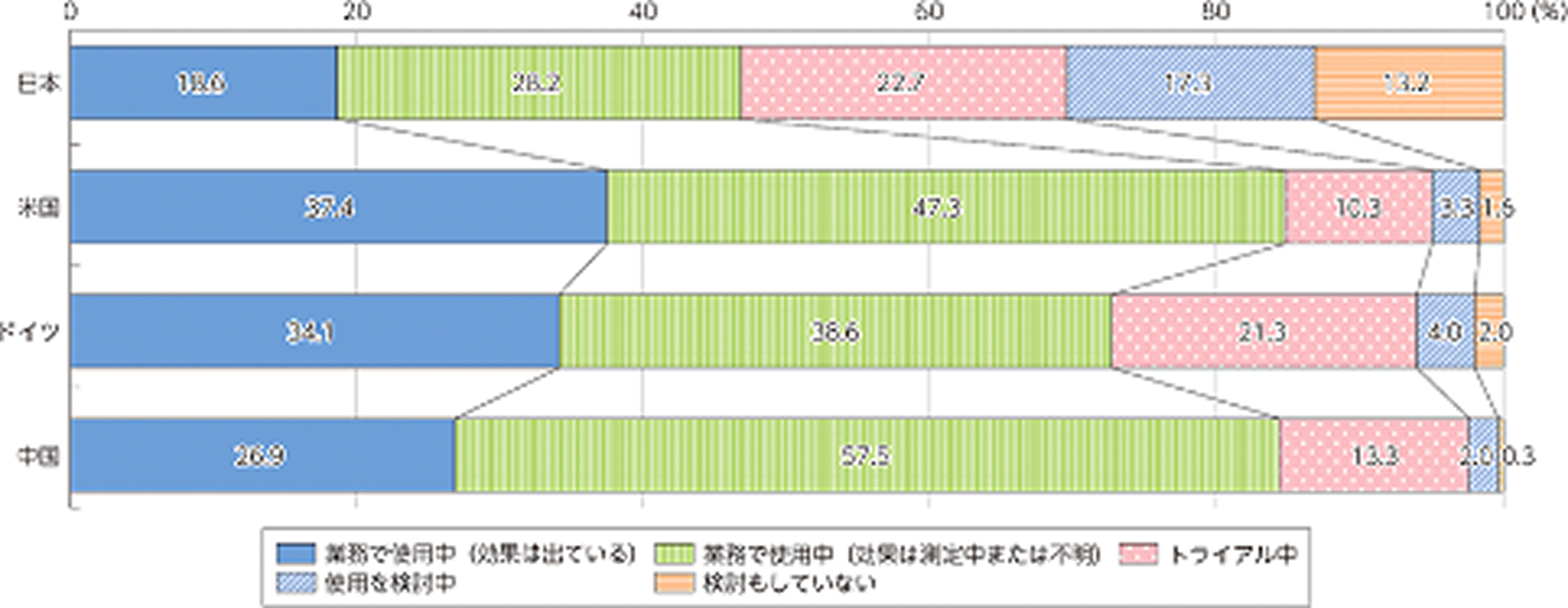
In addition, only 15.7% of Japanese companies said they had a policy of actively using generative AI, a major gap compared with China’s 71.2%. In Nikkei BP’s own survey published in September 2025, only 14.4% of employees at Japanese companies felt that their company’s use of generative AI was “very advanced” or “advanced,” while 34.1% felt it was “behind” or “very behind.” Paid generative AI tools may well be used personally or at the department level, but there is still no clear survey data on how many companies use them company-wide. It is likely that the number is not very large.
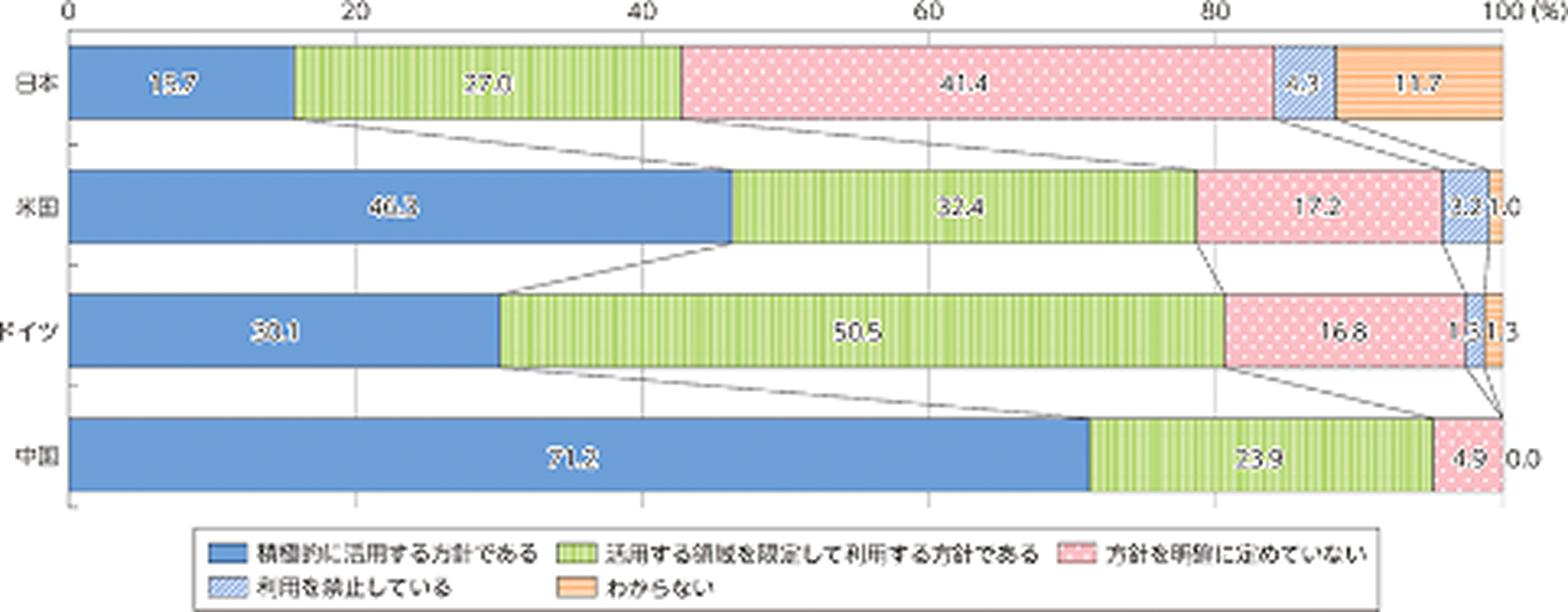
Given this situation, progress in using AI to improve or transform business processes and systems has been slow. In fact, the very idea of “using AI for work” often reflects a view of AI only as a tool for efficiency and cost reduction. AI should instead be seen as something that transforms business beyond operational efficiency.
Why have Japanese companies been unable to use AI effectively in business? Why has AI transformation not advanced?
The reason is that management has not viewed AI at the strategic level. In the Nikkei BP survey mentioned earlier, companies where employees felt AI adoption was lagging tended to have leaders who were not using generative AI themselves and had not presented a policy for AI use. In other words, leadership commitment to AI was lower than in companies viewed as more advanced. When it comes to generative AI, have companies purchased paid licenses for every employee, or only for specific departments? Leaders should not only use AI themselves but ensure that all employees use it as well. Do you perhaps believe your employees would not be able to use generative AI effectively? You do not learn to use generative AI and then become able to use it. Rather, by actually using it, you discover how to use it well. That is why the first step should be to purchase paid generative AI licenses for all employees. If the cost of those licenses is a concern, please contact us.
Today it is taken for granted that each employee is given a computer to do their work, but that environment only became normal around the late 1990s. Windows 95 launched in 1995, bringing powerful and affordable PCs into the market, while internet infrastructure also began to improve, greatly expanding how people gathered information and communicated at work. It may sound surprising, but email only became common in companies in the late 1990s. PCs spread through organizations at astonishing speed, and people began communicating inside and outside the company by email. Today, it is hard to imagine business without information devices such as computers. Then in 2023, many people began using ChatGPT, the flagship of generative AI, and in 2024 businesses also began adopting it. Its spread and penetration have been far faster than anything seen in the late 1990s. Just as PCs and email became normal, AI use will become normal ten years from now. Something far beyond using generative AI for efficiency in day-to-day work will happen. AI will move beyond assisting with email replies and begin replying automatically. Rather than helping salespeople and marketers use SFA or CRM systems, AI will make decisions, send emails, and set appointments in place of sales and marketing staff. Just as business leaders thirty years ago strategically introduced PCs and computer systems, today’s leaders must strategically introduce and use AI. And AI may go beyond simple IT adoption or DX. Digital transformation is sometimes criticized as having been little more than digitization, but AI transformation (AX) will not end up being merely “AI-ization.” IT cannot do more than what humans design it to do, but AI can go beyond what humans explicitly design, and one of its key features is that it can improve through input and output data. This may sound extreme, but starting with the question, “How can we let AI handle all of our work?” is strategic vision. Of course, current AI technology cannot do everything, but there are many areas it can already handle or partially replace. And just as companies used IT adoption as a trigger for business process reengineering (BPR), they must now use AI adoption as a trigger for reengineering their work.
Talent Shortages and the Data Skills Gap
Innovative managers have already recognized the potential of AI and are driving not only their own use of AI but also employee use across the organization. Even so, they may still hesitate to advance AX across the entire company. Three likely reasons are: 1) a shortage of people who can carry out BPR on the assumption of AI, 2) a shortage of AI talent, and 3) insufficient preparation of data and data infrastructure needed for AI use. Let us look at each in turn.
Shortage of People Who Can Do BPR on the Assumption of AI
BPR is important for companies even without AI, but unlike routine improvement, it is not something organizations work on continuously. Business Process Reengineering (BPR) was proposed in 1993 by former MIT professor Michael Hammer and management consultant James Champy and became a global concept. It means fundamentally reviewing and reconstructing the entire business process to dramatically improve performance in cost, quality, speed and other areas. Unlike individual process improvement, it is a comprehensive reform that reviews jobs, organizational structure, information systems, and more. The key point is the word dramatically. BPR is reform on the scale of cutting headcount or workload by half or more. As of July 2025, more than half of Japanese business leaders recognize talent shortages as a management issue (according to Teikoku Databank), but this is also an opportunity for AI adoption. If there are tasks AI can replace, companies should actively substitute them, and AI-based BPR can dramatically reduce workload through fundamental transformation. BPR does not require knowing every AI technology in detail. More important is having people who can view the entire business from above and think comprehensively from a zero base. Such people must question existing operations and imagine what ideal operations should look like. Of course, companies need to work on BPR internally, but when thinking on the assumption of AI use, they should also consider the role of the FDE (Forward Deployed Engineer). An FDE is an engineer who enters the customer’s field environment, deeply understands the customer’s operations, bridges technology and business, and supports the development, implementation, and operation of systems that solve problems and enable business development. What is distinctive is that the FDE enters the customer’s field and remains responsible until results are achieved. Accordingly, an FDE needs not only strong technical skill but also communication ability and business understanding. At the same time, many companies face the problem that no one inside the organization can use AI effectively. This cannot be solved overnight. It is naturally necessary to have people in-house who can use AI, but the first step should be to quickly obtain the knowledge, know-how, and capabilities of AI-capable personnel from outside and transfer them internally. Until now, companies have often left system development to system integrators that develop, build, and operate systems, but this approach does not transfer knowledge, know-how, or capability for system development to the company itself. Ideally, companies should work on AX together with firms that have FDEs and explicitly transfer AI knowledge, know-how, and capability. For that reason too, companies must urgently secure personnel with basic in-house knowledge and know-how.
Shortage of AI Talent
In the previous section, we noted the need to urgently secure AI talent with basic knowledge and know-how inside the organization. So what specifically should be done? Here, AI talent does not mean people who can simply use generative AI. It means people who can develop AI systems. Accordingly, the approach presented here is to cultivate advanced personnel who can develop AI-based systems, provided the company already has engineers with IT skills. First, they need to acquire foundational skills. To develop AI systems in-house, companies need to build AI agents and MCP servers, and that requires broad understanding of foundational technologies. In programming, that includes Python, JavaScript, and TypeScript. For cloud platforms, personnel need to be able to operate IaaS and PaaS environments such as AWS, GCP, and Azure. For API and microservice design, they need REST, gRPC, Docker, and Kubernetes. For data foundations, they need SQL and NoSQL. For AI fundamentals, they need machine learning frameworks such as PyTorch and TensorFlow, agent frameworks such as LangChain, LlamaIndex, and Haystack, and for natural language processing they need RAG (Retrieval-Augmented Generation). It may not be necessary to master every one of these technologies completely, but to develop AI agents and MCP servers that can replace internal work, companies must cultivate full-stack engineers with this kind of broad knowledge. It goes without saying that it is unrealistic to expect people with no past engineering or programming experience to master such advanced technologies, so this should at minimum be targeted at those with prior engineering or programming backgrounds. Second, foundational skills must be strengthened. FDEs enter the customer’s field environment, deeply understand the customer’s work, bridge technology and business, and support the development, implementation, and operation of systems that solve problems and enable business development, making them ideal as sources of AI technology transfer. In other words, companies should bring in external FDEs and form teams of external FDEs and internal advanced personnel to transfer technology. Once the transfer is complete, the internal personnel can become FDEs themselves, and those internal FDEs can then train the next generation inside the company.
Insufficient Preparation of Data and Data Infrastructure for AI Use
Data is essential for effective AI use, but in Japanese companies data is often fragmented by department. Sales uses CRM, manufacturing uses CAD/CAM, IoT, and PLM, and administrative functions use ERP. In other words, systems are siloed and no cross-functional, integrated data foundation exists. In addition, many companies still have strong paper-based and Excel-based cultures, and many operate macro-heavy Excel sheets to compensate for large systems. The reality is that data is often not digitized at all or is accumulated only as unstructured data. AI requires data, but many executives and leaders may believe they cannot move into full-scale adoption because the data is missing. However, AI has evolved. Ten years ago, data preparation was necessary for machine learning and deep learning. Today it is not. As anyone using generative AI can see, these systems learn from many different types of internet data, and it is no longer even necessary to prepare only structured data. The old saying that “data is a corporate asset, and unstructured unusable data is not an asset” is now outdated. Today, as long as it is electronic data that AI can read, it can be treated as an important corporate asset regardless of format. That said, it should be added that even AI still requires metadata definitions such as data labels and data meaning.
Organizational Culture and Resistance to Change
Perhaps the biggest reason Japanese companies struggle to use AI is their tendency toward risk avoidance. Behind this are both institutional and organizational-cultural factors. While this cautious stance helps preserve corporate stability, it also contributes to the loss of growth opportunities in today’s global competitive environment.
A Safety Orientation Rooted in Institutions
Even though lifetime employment and deduction-based personnel evaluation systems are no longer fully practiced, these systems formed the foundation of traditional Japanese-style management and still influence the behavior of managers and employees. Even now, there is an implicit understanding based on labor law that employment should be maintained, and if personnel evaluation is run on a deduction basis, employees will avoid failure rather than challenge themselves. Fear of failure encourages a safety-first attitude that prioritizes continuity and stability over investment for growth. In recent years, even the image of long-term growth has started to waver. Data from Japan’s National Institute of Science and Technology Policy show that compared with U.S. companies, Japanese companies have lower growth rates in R&D spending and capital investment, both of which shape future growth potential. Unlike overseas companies that have become more oriented toward short-term earnings, Japanese companies stand out for a caution that prevents them from making necessary investments in both the short and long term.
Japan-Specific Organizational and Cultural Barriers
The tendency toward risk avoidance is also deeply connected to corporate culture. First is a decision-making process that places heavy emphasis on consensus building. In Japanese corporate culture, gaining agreement from everyone involved through processes such as ringi and nemawashi is considered important. This has the advantage of reducing mistakes and preserving quality and reliability in the decision-making process, but it also takes a great deal of time. In today’s environment, where companies must respond quickly to market changes, it makes it difficult to take risks and try new initiatives. Second is a zero-risk orientation. When a new business or project is proposed, senior leadership and decision-making bodies tend to focus not on the possibility of success but on proof that it will not fail, precedent-based thinking, and evidence against the risk of failure. Combined with a highly earnest national temperament, proposals are often cut down from a negative perspective, resulting in management that does not take risks. Third is Japan’s distinctive collectivist culture. When homogeneity and conformity are strong, it becomes difficult to challenge existing values and customs, and organizations prioritize “the way things have always been done,” harmony, existing rules, and ensuring no one loses out over change and innovation. As a result, the organization as a whole becomes conservative.
Chapter 3: How to Introduce AI Transformation
In this chapter, we present hints on how to use AI to transform business operations, divided into 10 steps.
Step 1: Clarify the Purpose of AI Use
Whatever you do, it is necessary to set the purpose, the goal, and the means to achieve them. For example: solve issue XXX, eliminate task XXX, cut lead time in half, or halve staffing levels. A wide range of management issues can be examined, but the key is to consider how to improve the quality, cost, and speed of the management resources of people, goods, money, and information. At this step, KGI (Key Goal Indicator), KPI (Key Performance Indicator), CSF (Critical Success Factor), and scenarios should be shared and aligned.
Step 2: Inventory Work and Identify AI Opportunity Areas
At this step, focus on the three S’s: SMALL, SPEED, and SUCCESS. The idea is to take a small action, achieve results quickly, and gain the fruit of success. For that reason, identify areas where impact is large and implementation is easy. At a fundamental level, you may have a desire to reduce a certain task or ultimately transform a certain operation, but before taking on a major hurdle, start small, move quickly, and succeed. To identify high-impact and easy-to-implement areas, find work that is quantitative and easy to understand by visualizing and breaking down workflows, implementing ABC (activity-based costing), and measuring ratios such as error rates and conversion rates. If the work is not yet clearly defined and visualized, this is the stage where a work inventory is needed. The output of this step is to select several use cases and score the impact each would have if achieved.
Step3: Visualize Data and IT Infrastructure
At this step, inventory the location, definition, quality, permissions, security, and data stores (databases, data lakes, data warehouses, Excel, etc.) of existing data, along with API connectivity. Because data is absolutely essential for AI use, the goal is to organize information about data.
Step4: Design the PoC (Proof of Concept)
The purpose of this step is to design the PoC. A PoC makes the three S’s described earlier concrete. Build something small, build it quickly, and make it succeed. An important point is that there is no failure in a PoC. There is only success because the result matched expectations, or the fact that it did not go as expected, and that fact itself leads to growth in the next stage. From among the use cases selected in Step 2, choose one that seems suitable for a PoC and define quantitative success criteria in advance. The deliverable is a PoC plan that specifies the scope, model, tools, evaluation method, and more.
Step5: Conduct the PoC
The purpose of this step is to conduct the PoC in practice. This can include actually building an AI agent, developing an MCP server, automating workflows with AI agents, running the developed application on an AI platform, or building RAG. The key deliverable is a working prototype. Documentation is preferable, but at the PoC level, lightweight documentation such as connection documentation should be sufficient. At this step, it is important to build the smallest real solution that can actually run in operations so people can feel, in practical terms, the effect of using AI. Because this PoC is implemented using the selected use case, the next PoC can either take on a use case not selected this time or consider scaling the same method by expanding application areas or data scope.
Step6: Risk Design
If the concept has been proven through the PoC, the next step is to begin applying it to the actual business. Real business operations must be run safely, so companies need to design and prepare controls for personal information, sensitive information, responses to errors, emergency guidelines, audit logs, and more.
Step7: Build the Organization for AI Use
In this step, after completing the PoC, the company creates the structure needed for full-scale internal deployment. Specifically, this includes adding use cases (such as expanding application areas or data scope), developing applications such as AI agents, and improving and extending the AI platform, while also strengthening the talent and organization needed to develop AI systems. At the same time, the company must also develop and strengthen the people who operate and use the AI that is built. Or, if headcount reduction is part of the objective, it may also be necessary to consider reassignment plans. The results of this step can be measured by indicators such as the number of AI applications developed, the number and quality of engineers, the reuse rate of existing applications, and the proportion of in-house development rather than external FDE support.
Step8: Develop, Operate, and Learn from the Pilot Version
At this stage, the company finally begins developing and operating AI systems to introduce AI into real work. Even though AI systems are being developed and operated in actual operations, this is still a pilot version, so the rollout should start with work that is small in scale and scope and that can be quickly addressed if anything goes wrong. The objective of this step is to implement development, operation, adoption, and improvement in the field, and to learn by actually introducing and running AI in real work. This includes reviewing the development phase, the operations phase, feedback from developers and users, and the cycle of evaluation and improvement. Deliverables may include operating procedures, an AI introduction results report, FAQs, and similar materials.
Step9: Full-Scale Deployment and Scaling
At this stage, rather than a pilot version, the company develops and operates AI systems for full-scale use in real business operations. This stage evaluates AI use from the perspective of return on investment. The development cost of the AI system and the return it produces are calculated and compared. Based on the expected ROI, the system development approach and the range of business processes covered are adjusted in order to maximize ROI. At this stage, it is necessary to develop the AI system, enable collaboration and integration between existing systems and AI systems, monitor access control in the AI system, handle errors, and set SLAs. ROI is the most appropriate evaluation measure.
Step10: Continuous Improvement
In the final step, the developed AI system must be improved continuously. The LLM and RAG models used to build the AI system may also need to be updated. The primary purpose of an AI system is business transformation, but once introduced it becomes part of the operation itself and therefore must be improved continuously. It cannot simply be built and left alone. Evaluation reports, improvement backlogs, and model update plans should be created as deliverables, while ROI monitoring, system quality improvement, and reductions in errors and incidents should be checked.
Chapter 4: Why Take Action “Now”
Japan’s workforce is shrinking rapidly due to population decline and aging, and productivity remains low even among OECD countries. Amid labor shortages and an increasingly complex management environment, a productivity revolution is essential. While the rest of the world is advancing transformation centered on AI as a core part of management, Japan remains at the efficiency-improvement stage. AI has now reached a point where anyone can use it, and companies that move early will gain first-mover advantage. The technology and environment are mature enough today that companies can learn through trial and error. AX is no longer a question of whether to do it, but whether to do it now.
Structural Change and the Coming “Productivity Revolution”
According to International Comparison of Labor Productivity 2024 by the Japan Productivity Center, Japan’s hourly labor productivity stands at 56.8 dollars, ranking 29th among the 38 OECD member countries. Japan’s labor productivity per worker is also low, at 92,663 dollars, ranking 32nd among the 38 OECD countries. Japan’s working-age population has continued to decline since peaking in 1995 and is projected to fall into the 67 million range by 2030 due to population decline and aging. In other words, the nation will have more than 10 million fewer workers than it did 25 years ago. This is an unavoidable structural constraint for companies. At the same time, the challenges businesses face are becoming more complex every year. Customer needs are diversifying, product life cycles are shortening, and global competition is intensifying. The traditional approach of hiring more people and covering problems through effort alone is no longer viable. In other words, Japan’s economy is now at a major turning point, and a true productivity revolution is absolutely necessary, requiring a shift from labor-intensive management to knowledge-intensive and creativity-intensive management. AI is at the center of that shift, but AI is not merely a substitute technology to compensate for labor shortages. Rather, it is an amplification technology that supports human creativity, judgment, and empathy. For example, automating back-office work is not just about efficiency. It is about intelligent reallocation, allowing employees to spend more time on creative work. In sales and marketing as well, AI can analyze customer data and enable more personalized proposals, improving the quality of customer experience. AI is not a technology for reducing people. It is a technology for maximizing human value. What Japanese companies must do from here is redefine productivity not in terms of labor cost reduction, but in terms of unlocking human potential.
The Structure of Global Competition Has Changed
Around the world, a wave that could be called a fourth industrial revolution centered on AI is spreading at accelerating speed. In the United States, Google, Microsoft, OpenAI, and Amazon are placing AI at the center of both management and products, fundamentally transforming their business structures. In China, companies such as Baidu, Tencent, and Alibaba are promoting AI as part of national strategy, and social implementation is progressing across education, finance, logistics, healthcare, and many other fields. In contrast, Japanese companies still often take a wait-and-see, cautious stance. As discussed in Chapter 2, relatively few companies have fully introduced AI into management. Many remain at the efficiency level, using tools such as RPA and chatbots, and only a limited number are linking AI to new business models or new sources of revenue. It may be tempting to see this merely as a problem of adoption speed, but the gap in AI use will determine corporate competitive advantage itself. Across all industries, companies that treat AI not merely as a tool but as part of management strategy will achieve very different results. The question is no longer how to use AI, but what to change with AI. For Japanese companies to regain their presence in global markets, they must redefine AI as a core element of management.
The Arrival of an Era Anyone Can Use
AI services such as IBM Watson used to be so expensive that only large companies and research institutions could afford them, but OpenAI’s ChatGPT can be used even for free, making it accessible to individuals as well. Most other generative AI tools are also generally available for free, and even paid versions are not prohibitively expensive, making AI use a familiar option for many companies. Even without specialized knowledge, business professionals can now use AI conversationally and effectively. In addition, cloud platforms such as Google, Microsoft, and AWS have prepared the environment for AI development, allowing companies to implement AI models safely in the cloud without building their own servers. And AI has already entered the stage where it can be naturally embedded into operations. Anyone can now use AI to complete knowledge work that once took white-collar employees significant time, such as strategy planning, analysis, writing, and presentation creation, in just a few seconds. AI is no longer a technology of the future. It has become deployable management infrastructure that anyone can start using today.
Securing a First-Mover Position
A major reason action is needed “now” is that companies can secure a first-mover position. Companies operating in competitive environments must differentiate themselves and move even one step ahead of competitors by launching new initiatives, innovating, creating markets, and creating customers. If they fall behind, they may even lose the market to competitors that have made AI their weapon. AI is not a technology whose success is still uncertain. Today, it has reached the peak of the hype cycle and can be considered to have crossed the chasm in the innovation cycle. Innovative companies and major high-tech firms are already adopting AI and producing concrete results through many different initiatives. Companies must quickly decide how to incorporate AI into business and how to respond to market innovation. However, according to The GenAI Divide: State of AI in Business 2025, a report published by MIT in July 2025, 95% of organizations fail to feel any impact even after investing in AI. On the other hand, 5% of companies have generated value on the scale of millions of dollars. So what are those 5% of successful companies doing? What they have in common is a clear strategy and a phased approach. The 10 steps explained in the previous chapter are precisely a structured version of the process those 5% of companies are practicing. Start small and expand while learning—this is the key to success. At a basic level, LLMs are a type of AI model trained on vast amounts of internet articles, books, and other data, enabling them to understand and generate human-like natural language. They can perform a wide variety of natural language processing tasks with high accuracy, including summarization, question answering, translation, writing, and programming support. ChatGPT and Gemini are conversational text-generation services built using LLM technology and represent one example of how LLMs are used. Generative AI prioritizes human-like output more than correctness and can process work at volumes and speed that humans cannot match, but that does not necessarily mean it learns exceptionally well. These limitations will likely be improved, but at present AI excels at processing simple work quickly and at scale, while not being well suited to complex and long-term projects. In other words, the successful 5% are using AI correctly within a limited scope. This also means AI is deeply integrated into existing business processes. It is not enough to use AI only for things like writing or summarization. AI must be embedded inside current systems. AI can analyze per-customer click-through data and instantly adapt the UI to optimize it for each customer, or respond automatically at the appropriate moment within marketing automation or sales force automation, allowing existing work to be handed over to AI. Companies that use AI effectively as a tool are not merely fitting it into existing business processes and workflows. They are evolving the business processes and workflows themselves so they can make the most of AI’s characteristics. AI adoption is still in its early stages, so companies that act early and build the foundation first will lead their industries. By contrast, companies that wait until competitors have already moved ahead with AI may gain efficiency from learning from competitors’ efforts, but catching up and overtaking them will require greater cost in hiring talent, accumulating know-how, and building AI platforms. Naturally, shareholders and investors are also watching corporate commitment to AI investment as part of the company’s survival strategy. A company does not need to be the very first mover, but if it waits until many others have already responded, the impact on shareholders and investors may grow and outside pressure may intensify. In short, AI transformation is not a question of whether to do it. It is a question of doing it now.
“Now” Is the Best Time to Learn—and to Fail
It is difficult to believe that most executives are underestimating AI adoption. However, they may find it hard to judge exactly when and how AI should be used. With new technology, moving too early can mean the technology is not mature enough to produce meaningful results, while moving too late means losing competitive advantage. So what stage are we in now? The answer is clear: now is just the right time. We are in a phase where implementation and learning can be pursued together. AI technology has matured sufficiently, and the tools and cloud environments are now in place. At the same time, security is being considered, and compliance, governance, and ethical standards are taking shape, creating an environment in which companies can experiment with confidence and absorb small failures. Of course success is the ultimate goal, but it is also important to approach this with a willingness to include failure in the learning process. The value of AI adoption comes first from using AI to improve operational efficiency, next from using AI to transform the business itself, and finally from accumulating internal knowledge through the trial-and-error process of implementing AI. By repeating small successes and failures through PoCs and pilot introductions, companies cultivate understanding, culture, and skills related to AI use, steadily increasing organization-wide AI literacy. Within a few years, the gap between companies that introduce AI and those that do not will become impossible to reverse. That gap will not simply appear as a difference in AI utilization. It will appear as a difference in the quantity and quality of learning. That is why the most rational choice is to begin now, while companies can still fail on a small scale.
Market Opportunity: Timing for Creating New Value
AI has the potential not only to improve existing operations but also to create entirely new markets and customer experiences. Up to now, humans may have made decisions based on the results produced by business intelligence tools, but in the future AI will analyze from multiple angles, make decisions, and actually move work forward. Shopping sites can provide real-time promotions and purchasing experiences optimized for each customer, and AI may drastically shorten drug discovery processes that used to take a very long time. AI is already outperforming human diagnosis in some cases by reading X-ray and MRI data with greater accuracy. These things are already practical today. If Japanese companies start by asking, “Can this be done with AI?” or “Can this be replaced by AI?” they can unlock larger market opportunities and create greater value. Companies that enter now may become pioneers in new markets. Entering at the early stage when a market is being formed—or helping form that market—is the greatest opportunity to build competitive advantage.
AI transformation is not about whether to do it, but when to do it. The answer is clear: starting now is the only choice.
Chapter 5: Conclusion — From “Introducing” AI to “Embedding” It in Management
As we have seen, AI is not merely a tool for improving operational efficiency; it has the power to change the very nature of management itself. Overseas companies are already shifting toward AI-first management. If Japanese companies fall behind this trend, the result will not be a temporary delay but a long-term loss of competitiveness. Creating entirely new businesses or driving technological innovation is not easy for any company. There are many attempts, and only a small number of technologies and business models survive to change the world. Japanese companies may not always be strong at this kind of challenge. However, the wisdom and ingenuity that enabled Japan to advance automation on the manufacturing floor and achieve high-quality mass production are uniquely Japanese strengths. One could even call them a signature capability of Japanese companies. If AI adoption and AI-driven BPR are understood as efforts to automate white-collar workplaces—a white-collar productivity revolution—then enormous potential lies ahead. As noted in the previous chapter, Japan’s labor productivity is extremely low. One reason is that evaluation often emphasizes time rather than results, and seniority-based culture still remains, preventing the optimal placement of specialized talent as in job-based employment. But the delay in digitization is still a major factor. IT investment itself has been limited, and investment in the people and organizations needed to use IT has also been limited, which has slowed operational efficiency gains. But now is the time to strategically embed AI into management and automate white-collar workplaces. By doing so, Japanese companies can dramatically improve productivity and aim for a top-tier position among OECD member countries. Improving productivity means creating more added value with fewer labor hours and fewer workers, which in turn enables companies to provide richer lives not only to employees but also to customers, partners, and all other stakeholders.
We encourage you to take on the challenge of moving from simply “introducing” AI to truly “embedding” AI into management.
Appendix: AI Adoption Readiness Checklist
Use this checklist to evaluate your company’s readiness for AI adoption.
Rate each item on a 5-point scale, then determine your readiness level based on the total score. The rating criteria are: 5 = fully in place, 4 = mostly in place, 3 = partially in place, 2 = under consideration, and 1 = not yet started.
Objectively assessing your company’s current condition is itself the first step toward solving the problem.
QueryPie AI can support your company’s AI transformation, so please feel free to contact us. To make that discussion more productive, we recommend completing and submitting this AI adoption readiness checklist in advance.
【1】Management Commitment (5 points each, subtotal: 25 points)
| No. | Checklist Item | Score (1-5) |
|---|---|---|
| 1.1 | Top management understands the importance of AI adoption and communicates it clearlyㅤㅤㅤㅤㅤㅤㅤㅤㅤ | |
| 1.2 | A clear vision and goals (KGI/KPI) for AI adoption have been established | |
| 1.3 | AI adoption is discussed regularly as an agenda item in management meetingsㅤㅤㅤㅤㅤㅤㅤㅤㅤ | |
| 1.4 | An executive owner for AI initiatives (CxO or department-head level) has been appointedㅤㅤㅤㅤㅤㅤㅤㅤㅤ | |
| 1.5 | Leadership demonstrates a stance that tolerates failure and values learning | |
| Subtotal | ㅤㅤㅤㅤ/25 |
【2】Budget Secured (5 points each, subtotal: 20 points)
| No. | Checklist Item | Score (1-5) |
|---|---|---|
| 2.1 | A dedicated budget for AI adoption has been securedㅤㅤㅤㅤㅤㅤㅤㅤㅤㅤㅤㅤㅤㅤㅤㅤㅤ | |
| 2.2 | Budget for initial investment (PoC and pilot) has been approvedㅤㅤㅤㅤ | |
| 2.3 | Ongoing spending on license fees (for generative AI, etc.) has been plannedㅤㅤㅤㅤㅤㅤ | |
| 2.4 | Budget for external experts (such as FDEs) has been securedㅤㅤㅤㅤㅤㅤㅤㅤㅤ | |
| Subtotal | ㅤㅤㅤㅤ/20 points |
【3】Human Resources (5 points each, subtotal: 25 points)
| No. | Checklist Item | Score (1-5) |
|---|---|---|
| 3.1 | A dedicated team or responsible personnel for promoting AI adoption has been assignedㅤㅤㅤㅤㅤㅤㅤㅤㅤㅤㅤ | |
| 3.2 | The company has personnel with basic AI and data science knowledgeㅤㅤㅤㅤㅤㅤㅤㅤㅤㅤㅤ | |
| 3.3 | An AI literacy education program for employees is being implemented (or planned)ㅤㅤㅤㅤ | |
| 3.4 | There is a collaboration framework with external experts (FDEs, consultants, etc.)ㅤㅤㅤㅤ | |
| 3.5 | There is a talent development plan that anticipates technology transfer and in-house capability buildingㅤㅤㅤㅤㅤㅤㅤㅤㅤㅤㅤ | |
| Subtotal | ㅤㅤㅤㅤ/25 points |
【4】State of Data Readiness (5 points each, subtotal: 20 points)
| No. | Checklist Item | Score (1-5) |
|---|---|---|
| 4.1 | The location and types of all company data, including data on individual PCs, are understood | |
| 4.2 | All business data has been digitized | |
| 4.3 | Data access permissions and security policies have been established | |
| 4.4 | Data quality (accuracy and freshness) is maintained above a certain level | |
| Subtotal | ㅤㅤㅤㅤ/20 points |
【5】Organizational Culture Readiness (5 points each, subtotal: 30 points)
| No. | Checklist Item | Score (1-5) |
|---|---|---|
| 5.1 | There is a positive atmosphere toward adopting new technologies and toolsㅤㅤㅤㅤ | |
| 5.2 | Cross-department collaboration and cooperation are functioning | |
| 5.3 | There is a culture of learning from failure, and challenge is encouragedㅤㅤㅤ | |
| 5.4 | Frontline employees understand the need for AI use and are interested in itㅤㅤㅤㅤㅤㅤㅤㅤㅤㅤㅤ | |
| 5.5 | There is little resistance to reviewing or transforming business processesㅤㅤㅤㅤㅤㅤㅤㅤㅤㅤㅤㅤㅤ | |
| 5.6 | Communication between management and frontline teams is smoothㅤㅤㅤㅤㅤㅤㅤㅤㅤㅤㅤㅤ | |
| Subtotal | ㅤㅤㅤㅤ**/30 points** |
Overall Evaluation
| Category | Score Earned | Maximum Score |
|---|---|---|
| 【1】Management Commitmentㅤㅤㅤㅤㅤㅤ | ㅤㅤㅤㅤㅤpoints | 25 points |
| 【2】Budget Securedㅤㅤㅤㅤㅤㅤㅤㅤㅤㅤㅤㅤㅤㅤㅤㅤㅤㅤㅤ | ㅤㅤㅤㅤㅤpoints | 20 points |
| 【3】Human Resourcesㅤㅤㅤㅤㅤㅤㅤㅤㅤㅤㅤㅤㅤㅤㅤㅤㅤ | ㅤㅤㅤㅤㅤpoints | 25 points |
| 【4】State of Data Readinessㅤㅤㅤㅤㅤㅤㅤㅤㅤㅤㅤㅤㅤㅤㅤㅤ | ㅤㅤㅤㅤㅤpoints | 20 points |
| 【5】Organizational Culture Readinessㅤㅤㅤㅤㅤㅤㅤㅤㅤㅤㅤㅤㅤㅤㅤ | ㅤㅤㅤㅤㅤpoints | 30 points |
| Total Score | ㅤㅤㅤㅤㅤpoints | 120 points |
Assessment Results and Recommended Actions
| Total Score | Rating | Assessment | Recommended Action |
|---|---|---|---|
| 96-120 points | A | Ready | You are ready for AI adoption. We recommend moving immediately to the PoC phase (Step 4). |
| 72-95 points | B | Good readiness | You are generally prepared, but some improvement is still needed. Strengthen the weaker areas within three months before full deployment. |
| 48-71 points | C | Needs improvement | Several areas need improvement. Prioritize executive sponsorship and budget allocation, and set a six-month preparation period. |
| 24-47 points | D | Insufficient preparation | You need to begin by building the foundation. Start with incorporating AI into management strategy and prepare the base over a one-year plan. |
| 23 points or less | E | Not started | The prerequisites for AI adoption are not yet in place. Start by educating management and formulating a strategy. |
Identify Priority Areas for Improvement
Please fill in the top three items with the lowest scores:
| Rank | Category | Specific Issue and Improvement Plan |
|---|---|---|
| 1 | ㅤㅤㅤㅤㅤㅤㅤㅤㅤㅤㅤㅤㅤㅤㅤㅤㅤㅤㅤㅤㅤㅤㅤㅤㅤㅤㅤㅤㅤㅤㅤㅤㅤㅤㅤㅤㅤㅤㅤㅤㅤㅤㅤㅤㅤㅤㅤㅤㅤㅤ | |
| 2 | ㅤㅤㅤㅤㅤㅤㅤㅤㅤㅤㅤㅤㅤㅤㅤㅤㅤㅤㅤㅤㅤㅤㅤㅤㅤㅤㅤㅤㅤㅤㅤㅤㅤㅤㅤㅤㅤㅤㅤㅤㅤㅤㅤㅤㅤㅤㅤㅤㅤㅤ | |
| 3 | ㅤㅤㅤㅤㅤㅤㅤㅤㅤㅤㅤㅤㅤㅤㅤㅤㅤㅤㅤㅤㅤㅤㅤㅤㅤㅤㅤㅤㅤㅤㅤㅤㅤㅤㅤㅤㅤㅤㅤㅤㅤㅤㅤㅤㅤㅤㅤㅤㅤㅤ |
Reference Sites
- https://www.pwc.com/us/en/tech-effect/ai-analytics/ai-agent-survey.html?utm_source=chatgpt.com
- https://kpmg.com/us/en/articles/2025/ai-quarterly-pulse-survey.html?utm_source=chatgpt.com
- https://survey.stackoverflow.co/2025/ai?utm_source=chatgpt.com
- https://www.deloitte.com/us/en/services/consulting/blogs/ai-adoption-challenges-ai-trends.html?utm_source=chatgpt.com
Want to see more?
Please fill out the form to unlock your exclusive content!